Key takeaway
- Predictive analytics for student retention: data, models and early warning alerts, evidence from Georgia State and Purdue, FERPA privacy, and how to start.
Predictive analytics for student retention uses historical and current student data to estimate which students are at risk of leaving, so staff can offer support early. Models give a risk signal. Advisors, tutors and financial aid teams decide what to do with it. This guide builds on our explainer of predictive analytics.
It is for university and college leaders, student success teams and data teams. It covers what retention means, which data and models are used, what the evidence shows, the privacy and fairness limits, and how AI agents change the work.
What is predictive analytics for student retention?
It applies statistics, data mining and machine learning to predict future outcomes, here whether a student continues. The National Student Clearinghouse Research Center defines retention as continued enrolment, or degree completion, within the same institution. Persistence is continued enrolment at any higher education institution, including a different one. Know which of the two your model targets, because a student who transfers is a retention loss but not a persistence loss.
What data do retention models use?
| Data | Example signals | Caution |
|---|---|---|
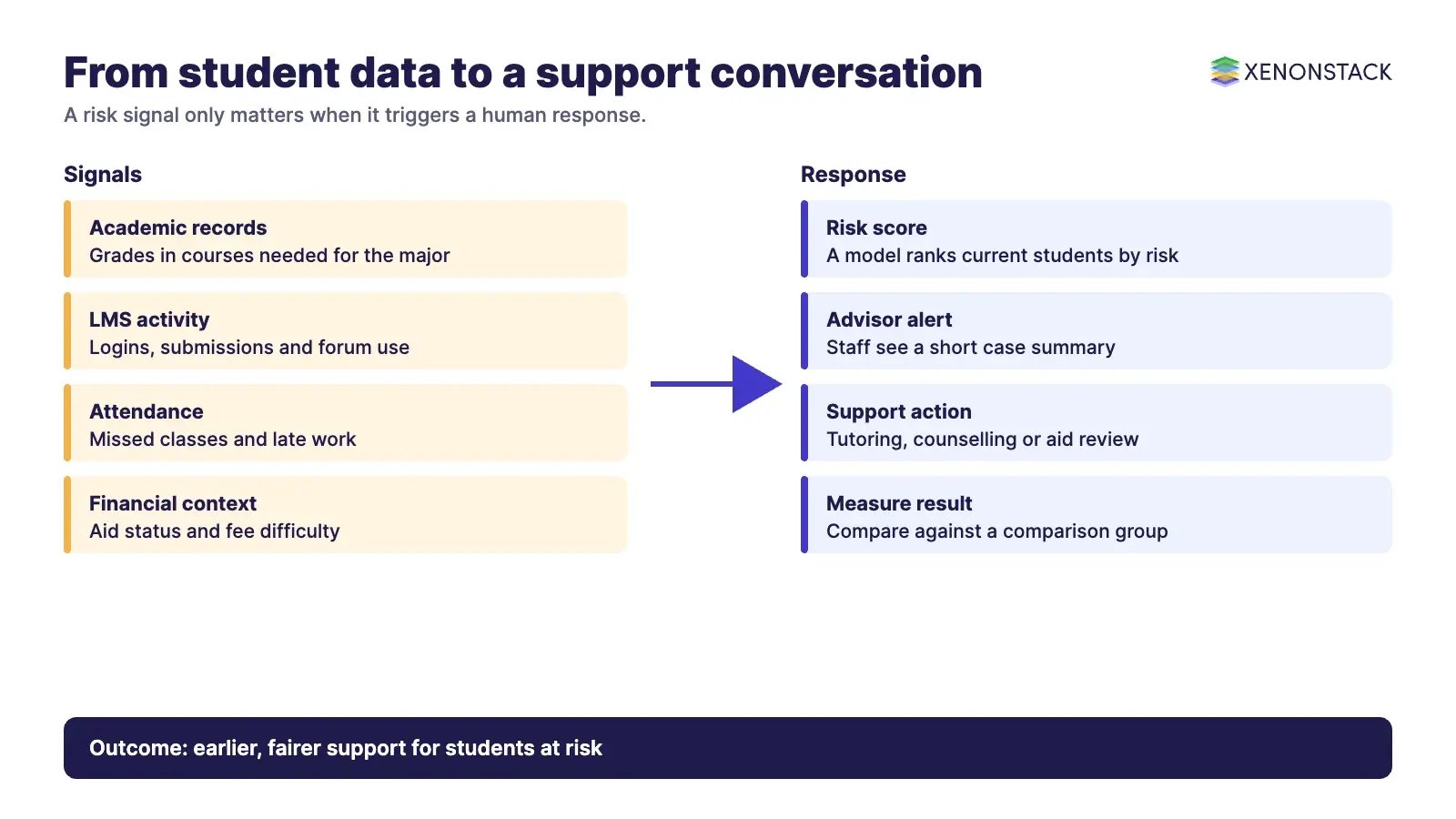
| Academic records | Grades in courses needed for the major, course failures | Lagging indicator: it shows trouble after it starts |
| Learning management system | Logins, assignment submission, forum activity | Activity is not the same as learning |
| Attendance and engagement | Missed classes, late work, co-curricular participation | Collect only what you can justify |
| Financial and demographic data | Aid status, socioeconomic background | High risk of unfair treatment if used carelessly |
| Surveys and staff notes | Feedback from teachers and peers | Subjective and uneven |
How does a retention model work?
Raw data is cleaned and missing values are imputed. Features are engineered from signals such as low grades, missed classes and little discussion activity. Decision trees, support vector machines and neural networks are trained on past cohorts to find patterns linked to leaving. The model then produces a risk score for each current student. The score triggers an action: extra tutoring, counselling, a conversation with an advisor or a review of financial aid. A score with no action attached changes nothing.
What does the evidence show?
Georgia State University is a widely cited example. A 2016 public radio report says the university analysed 2.5 million grades earned over 10 years and built an early-warning system with more than 700 red flags that updates daily. An alert triggers no automatic consequence. It is, in the report's words, the catalyst for a conversation. The university also hired 42 more advisors, bringing caseloads down to 300 to 1, and the report says staffing made up more than 90 percent of the project's cost. It reports that graduation rates were up six percentage points since 2013. The report presents these as the university's own claims and does not independently verify them.
Purdue's Signals system shows the risk of over-claiming. A 2013 news report describes a red, yellow or green status shared with instructors, and records an academic's challenge to Purdue's claim of a graduation benefit from taking Signals courses: the argument was that students who persist take more Signals courses, not the reverse. Purdue's own representative called for more research. The lesson is to test an intervention against a comparison group before crediting it.
What are the limits: privacy, bias and transparency?
Student data is protected. The US Department of Education FERPA page explains that FERPA governs how schools handle education records and that disclosure of personally identifiable information generally needs written consent, with an exception for school officials who have legitimate educational interests. Check the rules that apply to your institution and your vendors before sharing data. Models trained on past outcomes can repeat past unfairness, so test results by student group and keep staff able to explain why a student was flagged.
How do AI agents change student retention work?
Agents can monitor the signals continuously, assemble a short case summary for an advisor, schedule outreach and track whether a student responded. The advisor keeps the judgement and the relationship, and each action needs a record of which data and policy it used. For that record, see ElixirData, XenonStack's Context OS.
What should you do first?
- Define the outcome: retention within your institution, or persistence anywhere.
- Fund the human response first: advisors and support services.
- Start with a few explainable signals and a simple model.
- Check privacy rules and test for unfair patterns across student groups.
- Measure results against a comparison group.
To map one decision your agents make, and the data and policy it depends on, book a Context Workshop. See what happens in the workshop.
Frequently asked questions
What is student retention predictive analytics?
It uses past and current student data to estimate which students may leave, so that advisors and support teams can act early.
What is the difference between retention and persistence?
The National Student Clearinghouse Research Center defines retention as continued enrolment or completion at the same institution, and persistence as continued enrolment or completion at any higher education institution.
Does predictive analytics improve graduation rates?
Georgia State reports higher graduation rates after combining alerts with more advisors, but that is the university's own claim. Purdue's Signals results were challenged, so test any programme against a comparison group.
Which data is used to predict student dropout?
Common inputs are academic records, learning management system activity, attendance, financial aid status and survey feedback. Use only data you can justify and protect.
How does FERPA affect student data analytics?
FERPA governs education records and generally requires written consent to disclose personally identifiable information, with an exception for school officials with legitimate educational interests.
Follow XenonStack on LinkedIn: XenonStack on LinkedIn for new guides on agentic AI, data and platform engineering.
Ready to put AI agents to work? Explore ElixirClaw, the agentic OS platform to build, orchestrate and govern AI agents.
Explore the XenonStack platform family: ElixirData · ElixirClaw · ElixirHub · NexaStack · MetaSecure · Neural AI · AgentGRC · AgentSRE · AgentAnalyst · AgentInstruct · AgentRAI · AgentScrum · AgentSearch · AgentForce · AI Aviator · SAIF Aviator · CohortIQ · XenonStack AI · XenonStack UAE