Key takeaway
- Employee attrition analytics compares leavers with stayers to find why people leave. See the factors, dashboard steps and what HR should check first.
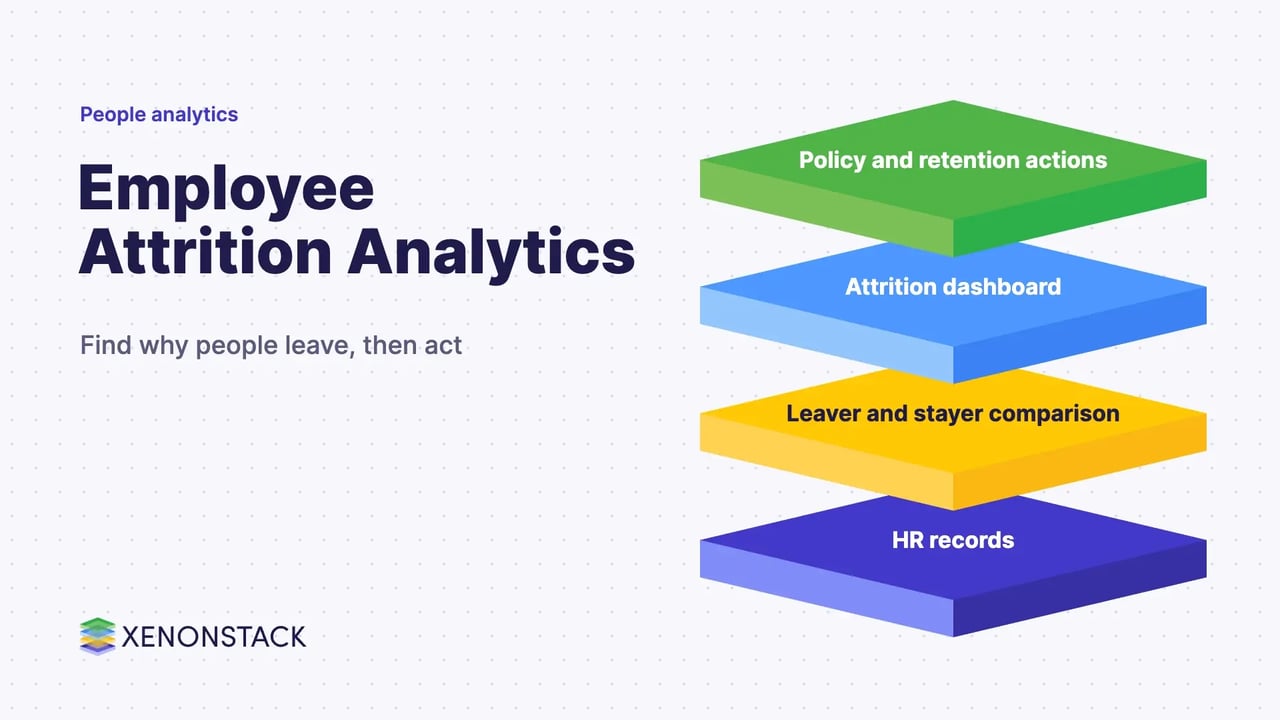
Employee attrition analytics combines HR records on people who left and people who stayed to find the factors that predict who is likely to leave, so that an organisation can change policies before it loses its best staff. A dashboard makes those factors visible to HR and business leaders.
This page is for HR leaders and people analytics teams. It covers the problem, the factors to analyse, how a dashboard works, where AI agents fit and what to check before you start.
What is employee attrition analytics?
Organisations want valuable employees to stay for a long time, and a rise in departures is a warning sign. Attrition analytics collects data on current and former employees and compares them, so that HR can see which conditions are linked to leaving. Wikipedia's entry on employee retention describes turnover as the rate at which employees leave, and notes that HR analytics is one way organisations look for root causes.
Why do employees leave?
There is rarely one reason. Typical factors to test include:
- Job involvement, which can be tracked through the number of projects an employee worked on.
- Career growth, including promotions and salary hikes.
- Performance ratings.
- Job satisfaction.
- Workplace safety, such as the number of accidents an employee has been involved in.
The same source also points to flexible work arrangements, inclusion and leadership as influences on whether people stay. Which factors matter most differs by organisation, which is why the data has to be analysed rather than assumed.
How does the attrition dashboard work?
A dashboard brings the factors together so that leavers and stayers can be compared side by side:
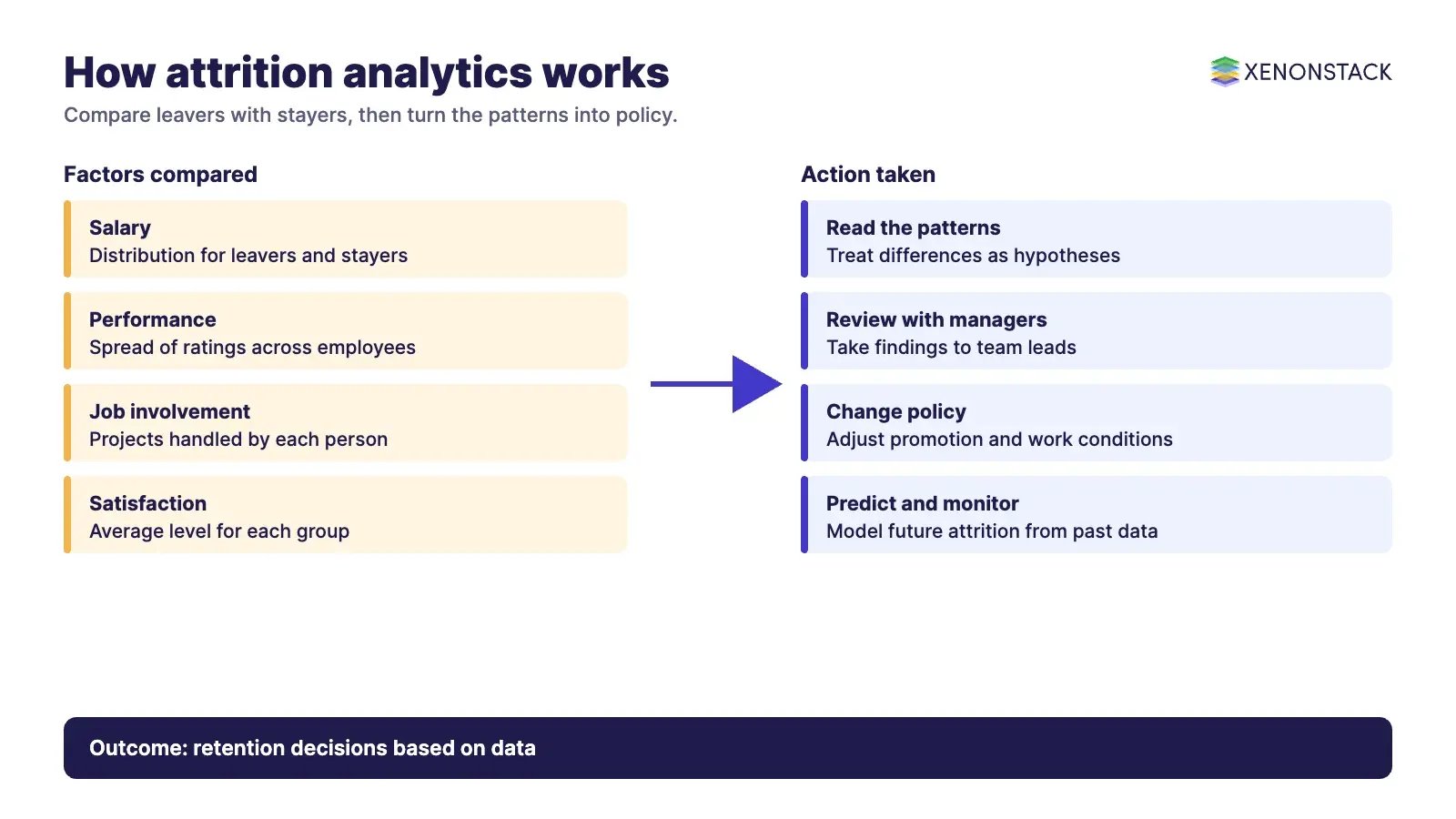
- Collect records for employees who have left and those still working.
- Compare salary distributions for the two groups, for example with a box plot.
- Review the spread of performance ratings and the number of projects each person handled.
- Check promotion scores, internal promotion rate, satisfaction levels and accident counts.
- Read the differences as hypotheses and take them to managers for policy decisions.
In a sample dashboard, salary ranges for leavers and stayers looked similar, which suggested pay was not the main driver, while leavers had been involved in fewer projects and had lower average satisfaction. Findings like these are specific to one data set, so test them on your own records.
How does attrition analytics compare with reacting to exits?
| Question | Reacting after exits | Attrition analytics |
|---|---|---|
| When do you learn the cause? | After people have gone | While there is still time to act |
| What evidence is used? | Exit interviews and manager opinion | Records on leavers and stayers compared together |
| What changes? | Individual fixes | Policy and environment changes based on patterns |
| Prediction | None | Models can estimate future attrition from past data |
Where do AI agents fit?
Beyond descriptive dashboards, machine learning models can estimate future attrition from past data. An agent can refresh the data, flag teams where the factors above are moving and prepare a summary for an HR partner to review. ElixirData is XenonStack's Context OS, a decision infrastructure platform for keeping data, policy and decision context together. People data is sensitive, so decisions about individuals should stay with people.
What should you check before you start?
- Which HR systems hold leaver, performance, promotion and satisfaction data, and how complete they are.
- Privacy rules and who may see employee-level data.
- Whether the data is comparable across teams and locations.
- Who owns the actions that follow the analysis.
- Whether you want a dashboard only or also a prediction model. You can request a demo of employee attrition and performance analytics.
To map one decision your agents make, and the data and policy it depends on, book a Context Workshop. See what happens in the workshop.
Frequently asked questions
What is employee attrition analytics?
It is the analysis of data on employees who have left and those who stayed, to find the factors linked to leaving.
Which data is used?
Typically salary, performance ratings, project involvement, promotions, satisfaction scores and workplace accident records.
Does low pay always cause attrition?
No. In a sample dashboard, salary ranges for leavers and stayers were similar, so other factors such as involvement and satisfaction mattered more. Check your own data.
Can attrition be predicted?
Machine learning models can estimate future attrition from past data and the factors analysed, though predictions should support, not replace, human judgement.
Where do AI agents help?
They can keep the data fresh, flag changing factors and prepare summaries for HR to review.
Ready to put AI agents to work? See an ElixirClaw demo: the agentic OS to build, orchestrate and govern AI agents across your enterprise systems.
Explore the XenonStack platform family: ElixirData · ElixirClaw · ElixirHub · NexaStack · MetaSecure · Neural AI · AgentGRC · AgentSRE · AgentAnalyst · AgentInstruct · AgentRAI · AgentScrum · AgentSearch · AgentForce · AI Aviator · SAIF Aviator · CohortIQ · XenonStack AI · XenonStack UAE